Two
hundred
years before the white man killed most of the wild turkeys
in
Wisconsin and deforested the State for subsistence
agriculture, the native Menominee, Ojibwe
(Chippewa), Potawatomi, and Ho-Chunk (Winnebago) people
lived off the
land. Two
hundred
years before the white man killed most of the wild turkeys
in
Wisconsin and deforested the State for subsistence
agriculture, the native Menominee, Ojibwe
(Chippewa), Potawatomi, and Ho-Chunk (Winnebago) people
lived off the
land.Imagine the difficulty of this white man traveling through Indian country in 1680. How he kept a fire going and managed to survive is astounding. I speculate he must have shot them off the roost at night, but however he managed to kill turkeys in Wisconsin's winter, it's remarkable: "he melted it to make balls for his gun, which had no flint. By firing it with a coal, he killed some turkeys on which he lived during that time." See highlight in this little known document (click on picture to the left). References to Le Sieur de Boisrondet. |
|
It took 5 long years to change the
rules to allow turkey dogs in Wisconsin, something that
should've been
allowed since the fall turkey season began. Why it
wasn't is a mystery.
Especially considering Wisconsin is the only state to
allow dogs to
hunt wolves and has been bear hunting with dogs for a
long time. Yet,
in 1876, Wisconsin was the first state to ban hunting
deer with dogs.
Here's a few from the archives:
|
 2004
Jon
Freis asked the Conservation Congress Turkey
Committee to
list fall turkey hunting with a dog on the April
Conservation Congress
Spring hearing agenda. The Turkey Committee declined, but
the Dog
Committee listed it. Lost in 46 of 72 counties. 2004
Jon
Freis asked the Conservation Congress Turkey
Committee to
list fall turkey hunting with a dog on the April
Conservation Congress
Spring hearing agenda. The Turkey Committee declined, but
the Dog
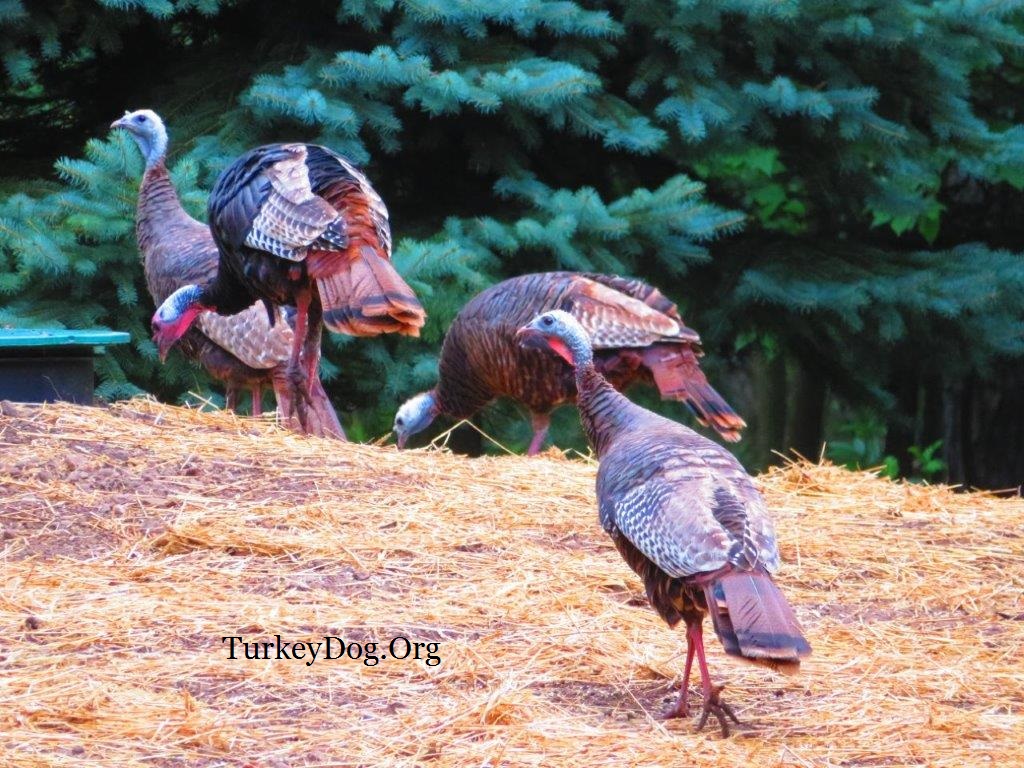
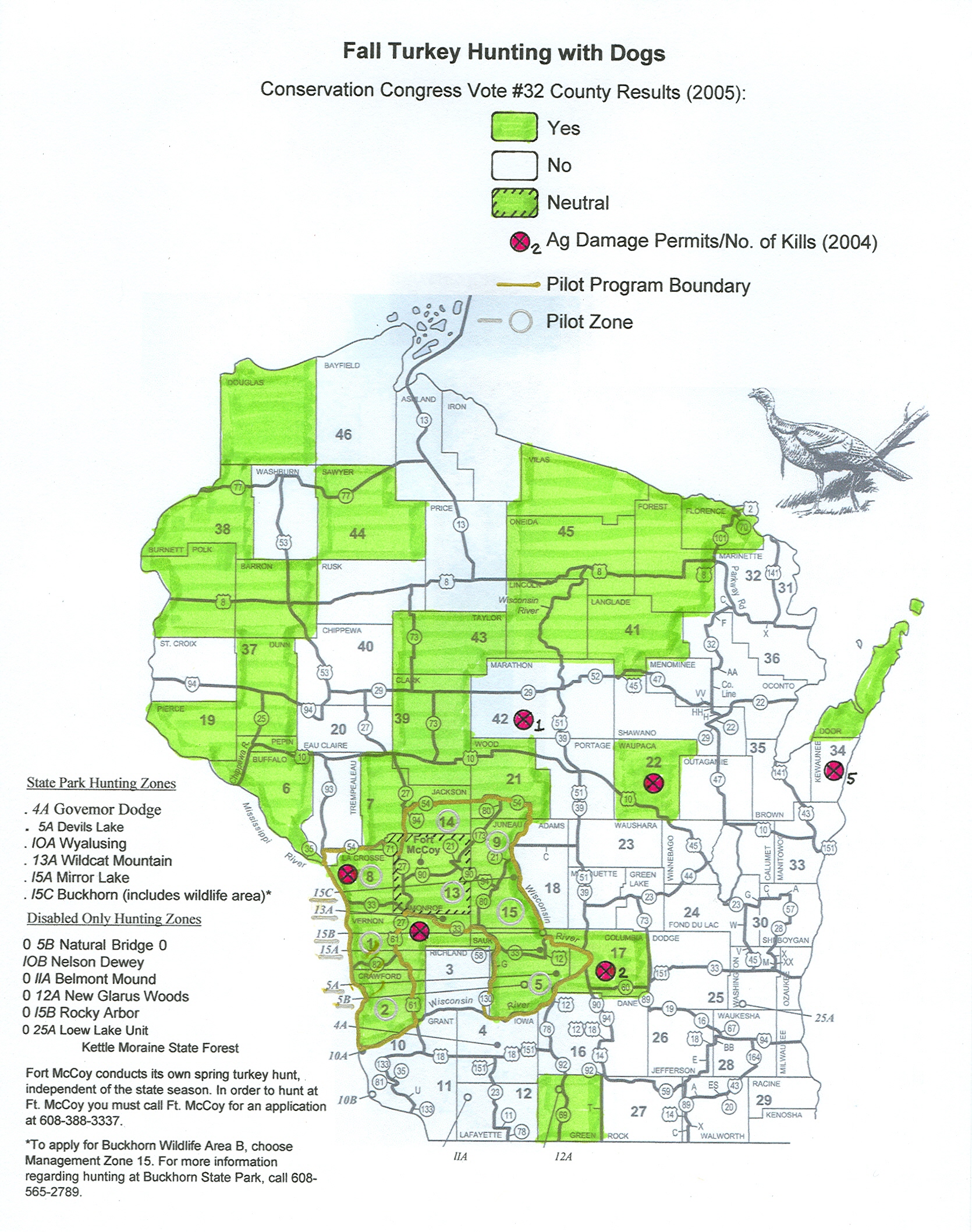
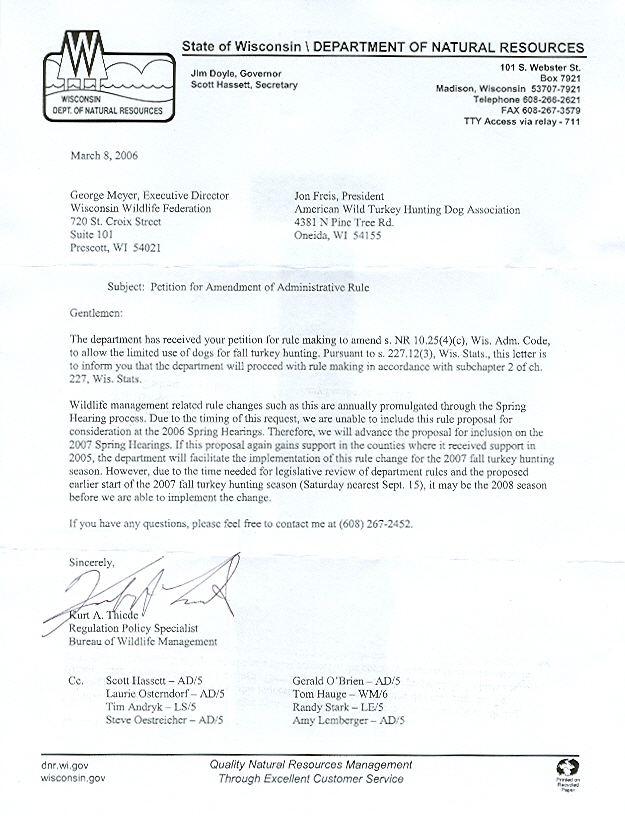
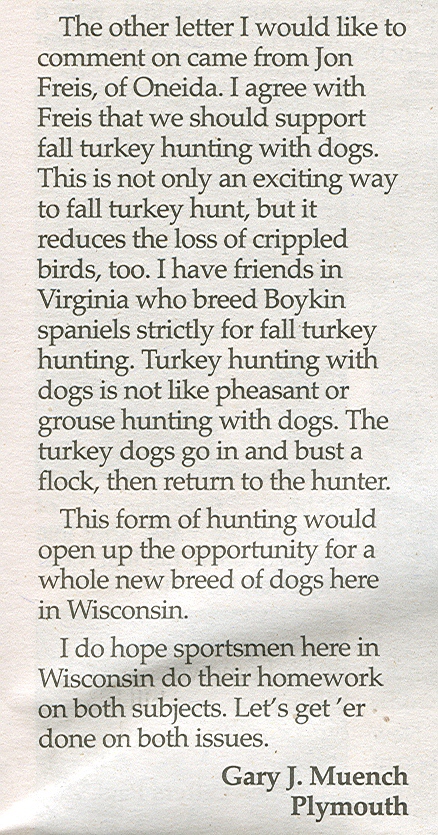
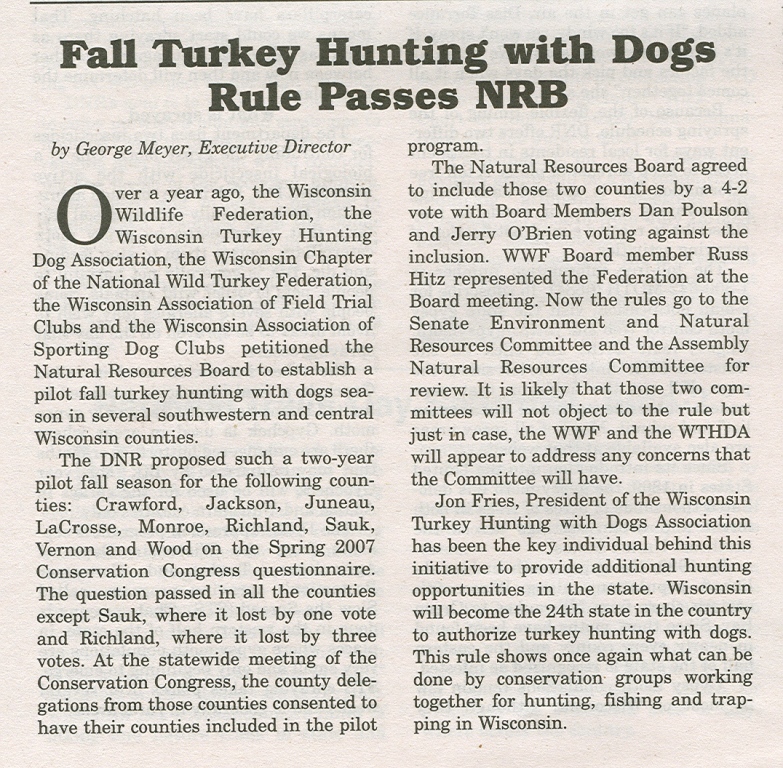
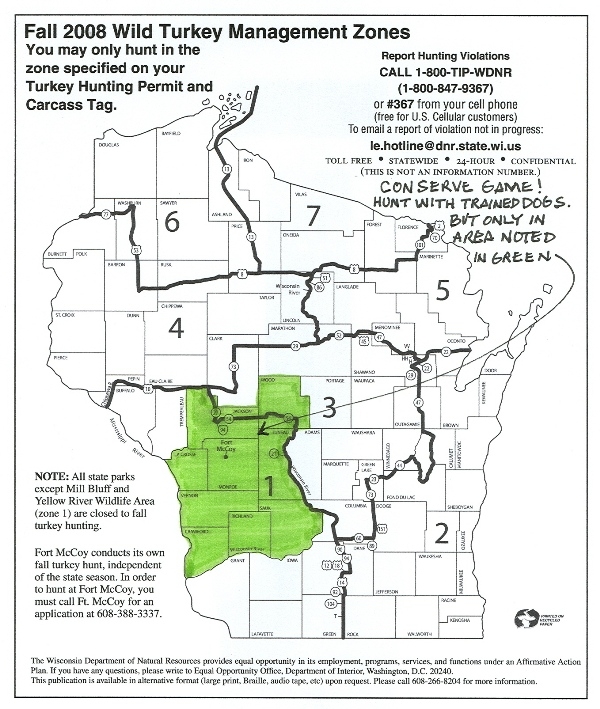
Committee listed it. Lost in 46 of 72 counties.2005 lost at the Spring Hearings again. 2006 put together 9 adjacent counties for a trial hunt. Only 7 voted for it, 1 lost and 1 tied (Monroe tied, Richland voted No. But their CC delegates agreed to be included in the trial hunt, if the 2007 Conservation Congress Spring Hearing vote is affirmative). 2007 on CC hearing agenda, to allow a 3 year trial in the 9 SW counties that approved it. Failed Statewide, but passed in the 9 counties, so the DNR approved it happening. This was supposed to be a 2 year trial, but the DNR changed it to a 3 yr. trial. 2007, 2008, 2009 had a 3 year trial hunt in 9 SW counties (started late in 2007 - October 1, because of procedures). But, after the fall 2008 season, I lobbied to list it on the 2009 CC ballot, for a statewide permanent hunt, based on the 2 years results of the pilot (dept. reports from field staff), as it takes a year to get it implemented through the CC Spring Hearing and the DNR/Legislative procedures. I was tired of traveling 3 hours to hunt turkeys legally with my dog. After 4-1/2 years of this, I was getting old and impatient, I didn't want to wait 3 more years (until the fall of 2011). 2009 Spring Hearing (to allow statewide) it lost again, 53 to 47%. May 27, 2009 Baraboo, Wisconsin. The AWTHDA, the WWF and the DNR recommended approving turkey hunting with your dog in the fall STATEWIDE, and the Natural Resource Board approved it unanimously. The only opposition was from the Conservation Congress. June 2009 It had to be approved by the Senate Transportation, Tourism, Forestry, and Natural Resources Committee and the Assembly Natural Resources Committee (Wildlife Committee chairs Senator Holperin and Representative Hraychuck), then the full Senate and Assembly. Then it has to be published in the Administrative Code by the Legislative Reference Bureau and it becomes law after 30 number of days have passed. 6/11/2009 It isn t on the house or senate committees docket yet. 7/14/09 Rule 09-015: relating to hunting and trapping regulations, closed areas and game refuges. Dear Chairman Holperin and Members, Senate Natural Resources Committee: The Wisconsin Wildlife Federation and the American Wild Turkey Hunting Dog Association would like to indicate our support for the specific rule proposed in DNR Rule 09-915 which establishes a statewide turkey hunting with dog season throughout the State of Wisconsin... George Meyer, WWF. 10/19/09 Congratulations - it's all signed, sealed, and delivered. Turkey hunting w/dogs goes statewide beginning with the 2010 season. 10/20/2009 Governor Doyle didn t have to sign it, because it s a dept. rule, only the legislature had to. 2010 Dogs are allowed Statewide, beginning in the fall of 2010. |
May
2004 Natural Resource Board
Wisconsin Outdoor News June 4, 2004
NWTF
Turkey Call magazine Nov/Dec 2004 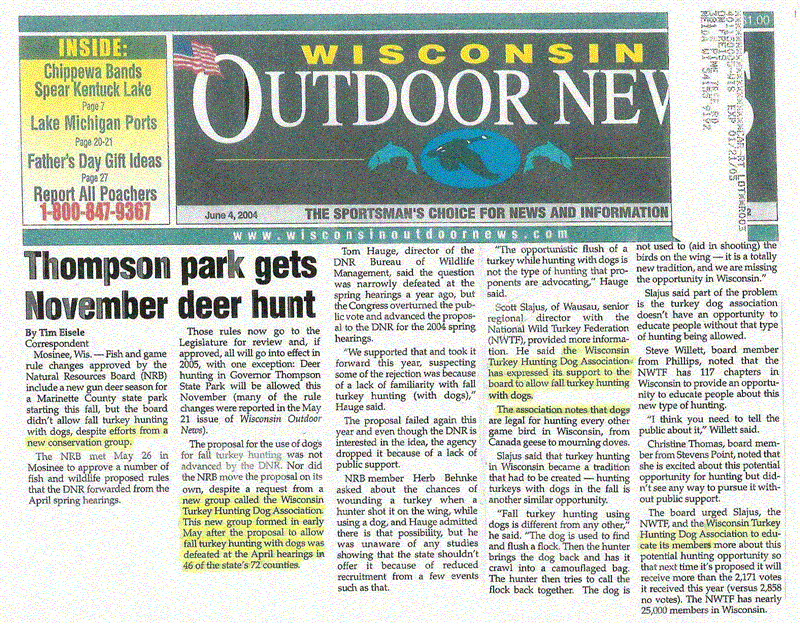 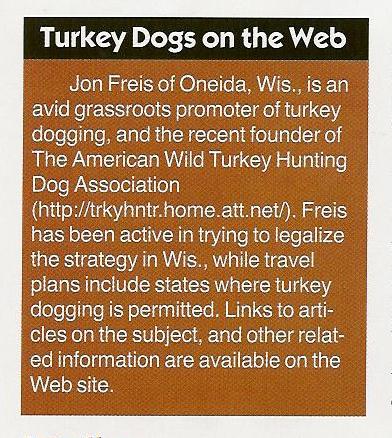 |
2004
United States Turkey Dog
Map
NWTF
- WI Turkey Call newspaper Winter 2005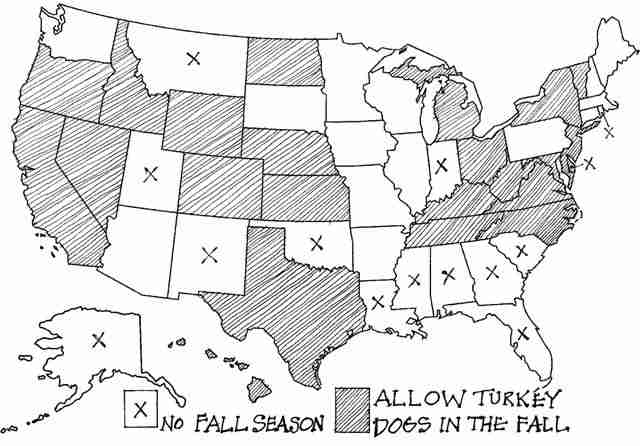  |
|
January, February, March 2005
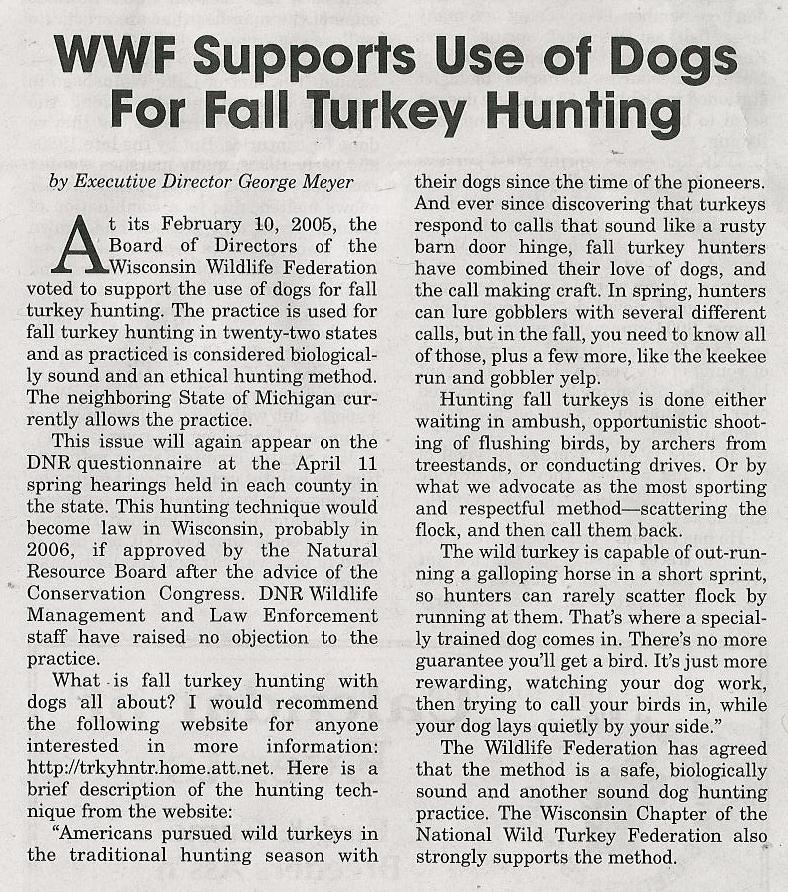 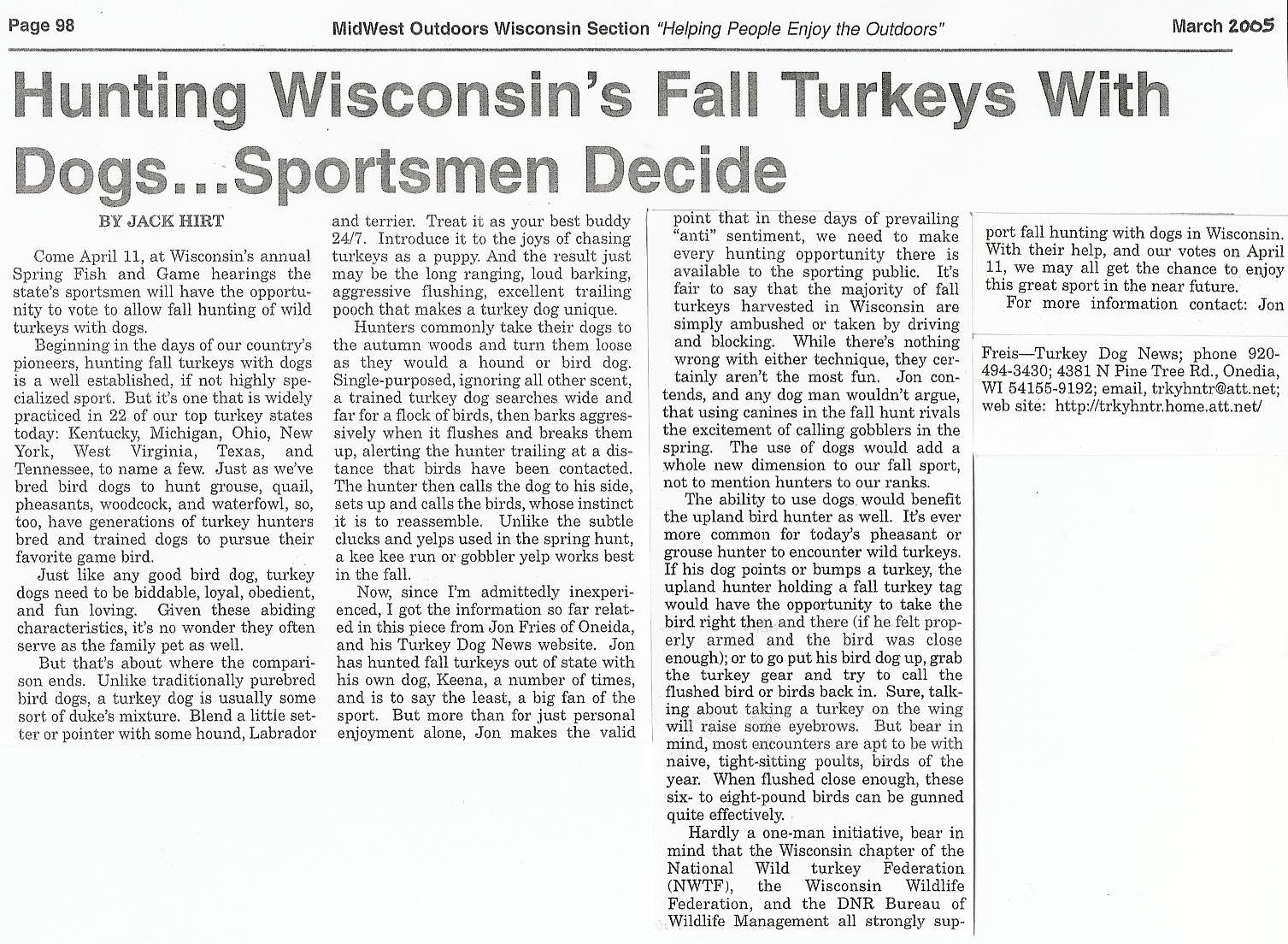 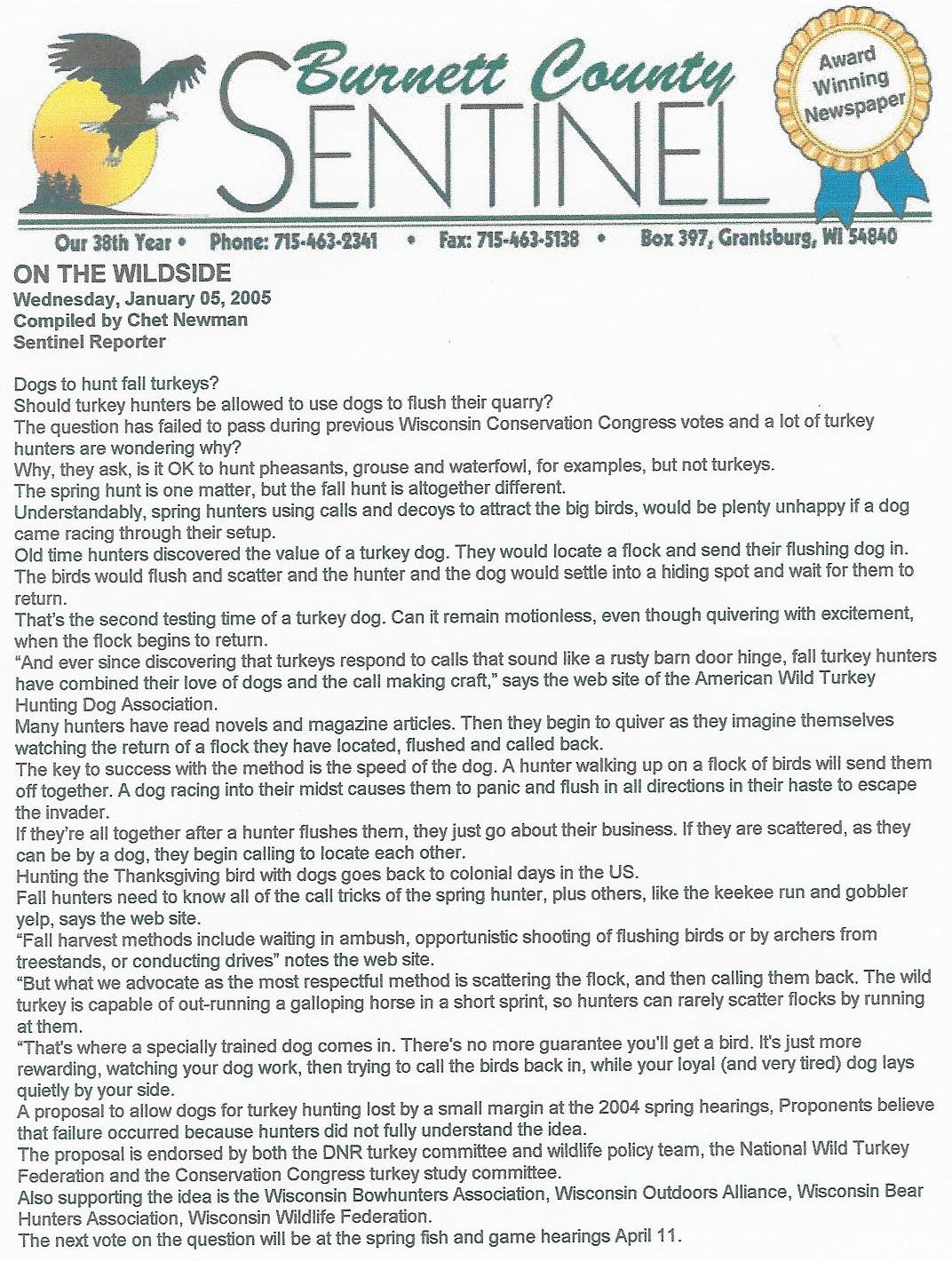 |
|
"In the French domains of North
America, the Jesuits frequently note them. Allouez at
Lake Poygan,
Wisconsin (1669-1670) says, there we saw two Turkeys
perched on a tree,
male and female, resembling perfectly those of France-
the same size,
the same color, and the same cry." Early
Records of
the Wild Turkey Albert Hazen Wright, 1914
    |
|
Same map for the Trial Hunt
Counties in 2007, 2008 and 2009
  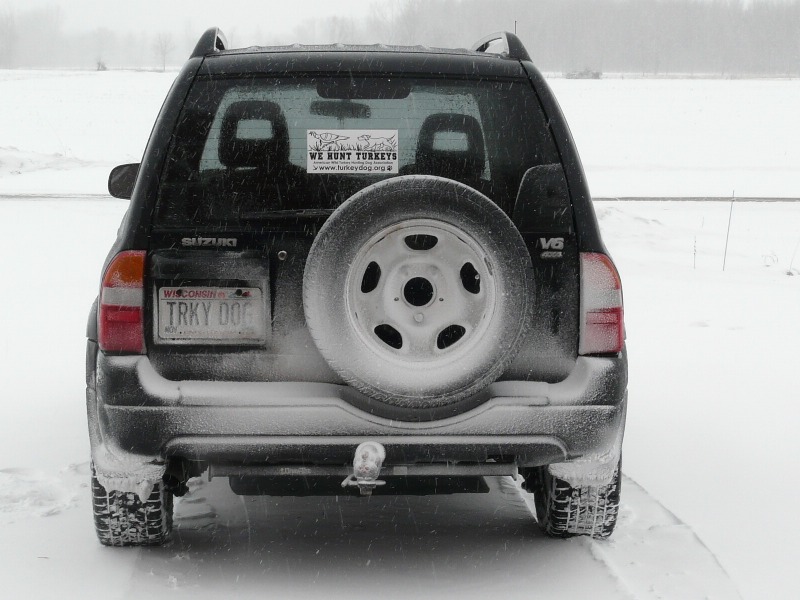 Some history: WISCONSIN Wild Turkey Restorations and Introductions by A. W. Schorger A Mr. Gordon of Janesville is said to have obtained two pairs of wild turkeys from the Indian Territory and released them in the woods on his place in 1887 (Schorger, 1942:180). By 1890 there was a considerable increase apparently due to mating with domestic turkeys. Hough (1891) stated that the Peck brothers of Janesville had a flock of wild turkeys which originated from half a dozen birds brought from Mexico. The state stocked about 3,000 pen-reared turkeys between 1929 and 1939 (Hopkins 1940). The birds went to farms and were insufficiently wary of predators and hunters. During a bow season in 1939, fifty four birds were killed by archers, a proof of lack of wildness. Human predation has been continuous. A few hours after some turkeys from the State Game Farm at Poynette had been released in the Baraboo Hills on July 8, 1938, four of them were killed by poachers (Anon.,1938.1) During the three years 1937-39, 507 birds were released in Sauk County. In 1937 five of these turkeys appeared at a farm at Hickory Bluff near Grand Marsh, Adams County, and associated with domestic turkeys. The last one died February 1, 1958 (Schorger, 1958). The state, after consultation with Roger M. Latham, in 1934 purchased sixty-nine turkeys of an improved strain from a game breeder in Pennsylvania (Wagner, 1954). They were released on the Central Wisconsin Conservation Area and on the Necedah National Wildlife Refuge, Juneau County. Additional releases of 217 birds were made in 1956 and 460 in 1957 (Plis and Hartman, 1958). In 1958 a minimum of thirty-four broods numbering 240 poults was observed. Some birds were reported thirty miles from previous release sites (Hartman, 1959). Turkeys have been observed in Juneau, Adams, Wood, Monroe, and Jackson Counties. The winter of 1958-59 was severe and the spring of 1960 exceptionally wet during the nesting season. As a result only ten broods containing forty-eight young, were observed during the summer of 1960 (Plis. 1960). p. 461 The Wild Turkey - Its History and Domestication; A. W. (Arlie William) Schorger, University of Oklahoma Press. |
|
Planning a fall turkey hunt in
Wisconsin?
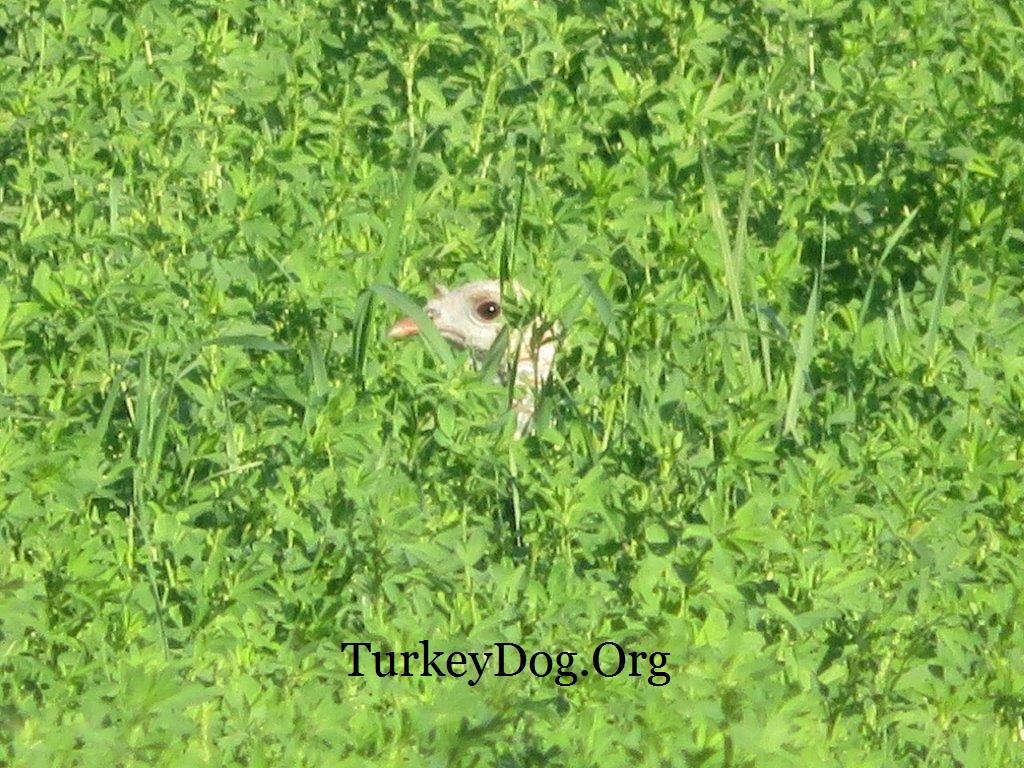 Wisconsin
has so much public land (5.7 million acres),
non-residents can easily
find a place to go. There are always more turkeys on
private land than
public (because there's more food on farmer land), in
the southern 2/3
of the state. If you're going to the north 1/3 to grouse
hunt too,
there are turkeys there, just not as many. It's a lot
bigger country
(big tracts of woods, plus it has wolves to avoid), with
less turkeys
per square mile. If you have time to talk to farmers,
you'll find about
8 or 9 out of 10 farmers will gladly let you fall turkey
hunt (there
are rare pockets of selfish oddballs like anywhere - if
you do
encounter anyone like that just write them off).
But, you
have to look for the dairy country, not the timber
country. In the
timber country like western Shawano or northern Waupaca
county, much of
the land is in Managed Forest Crop Law (Closed to the
public and leased
out- thanks to the new rules our wonderful politicians
made allowing
the tax break without giving anything in return to all
the taxpayers
who are subsidizing them). It's easy to spend more time
talking to
farmers than you do hunting, so that's a consideration
too, on whether
to hunt public or private land. Generally, the public
lands are bigger
tracts than private. If you have a big running dog, you
might prefer
public lands so you don't have to worry about roads, or
encroaching on
neighbors lands. But then, if you hunt private land,
your dog is more
likely to enounter turkeys close and never leave the
farm you have
permission on anyway. Either way it's enjoyable, it just
depends on
what kind/size of terrain you prefer. Wisconsin
has so much public land (5.7 million acres),
non-residents can easily
find a place to go. There are always more turkeys on
private land than
public (because there's more food on farmer land), in
the southern 2/3
of the state. If you're going to the north 1/3 to grouse
hunt too,
there are turkeys there, just not as many. It's a lot
bigger country
(big tracts of woods, plus it has wolves to avoid), with
less turkeys
per square mile. If you have time to talk to farmers,
you'll find about
8 or 9 out of 10 farmers will gladly let you fall turkey
hunt (there
are rare pockets of selfish oddballs like anywhere - if
you do
encounter anyone like that just write them off).
But, you
have to look for the dairy country, not the timber
country. In the
timber country like western Shawano or northern Waupaca
county, much of
the land is in Managed Forest Crop Law (Closed to the
public and leased
out- thanks to the new rules our wonderful politicians
made allowing
the tax break without giving anything in return to all
the taxpayers
who are subsidizing them). It's easy to spend more time
talking to
farmers than you do hunting, so that's a consideration
too, on whether
to hunt public or private land. Generally, the public
lands are bigger
tracts than private. If you have a big running dog, you
might prefer
public lands so you don't have to worry about roads, or
encroaching on
neighbors lands. But then, if you hunt private land,
your dog is more
likely to enounter turkeys close and never leave the
farm you have
permission on anyway. Either way it's enjoyable, it just
depends on
what kind/size of terrain you prefer.A good plan would be to target some public land with farm land surrounding it and then whether you get permission or not, you can always hunt the public land. We have lots of national forest, state forest, county lands, Forest Crop Lands and Managed Forest Crop Lands that are open to hunting, so you have to consult a number of sources to find it all. The old fashioned plat book of the county is still the best map, you can generally order them through the 4-H clubs on the county websites. Most of the county websites have GIS maps with contours and aerial maps, if you can figure out how to navigate them (each one is different). There are so many ways to pre-scout with the internet today, you can even determine things like squeeze points, looking at aerial maps, combined with the county terrain contours. Our DNR maps have aerials you can use for both public and private lands. If you want to trout fish at the same time too, check out these maps. I'm waiting for the GPS with aerial views, contours and the plat book  all
put
together. all
put
together.It's not a good idea to plan a hunt during the buck rut (starting the first week of November), because the public land is full of archers, farmers relatives are after the 'big one', and they don't want you in there with your dog chasing turkeys and disrupting the monster bucks they have patterned! That time is good for hunting public land after the archers leave in the morning and before they hunt in the evening. Or on that rare farmers land where they're not so crazy about deer (good luck). For a local guide and outfitter, call Jon 920-776-1272 |
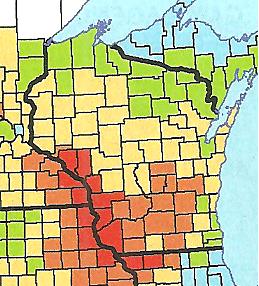  Maps like
the one on the left (portion of the 2015 Fall Turkey
Hunting Forecast
Map the NWTF published in the Sept/Oct '15 Turkey Country
magazine, p.
101) show turkey populations based on the Forest Cover
Metric.
This uses an inaccurate prime metric for determining
the
turkey population and permits made available. Maps like
the one on the left (portion of the 2015 Fall Turkey
Hunting Forecast
Map the NWTF published in the Sept/Oct '15 Turkey Country
magazine, p.
101) show turkey populations based on the Forest Cover
Metric.
This uses an inaccurate prime metric for determining
the
turkey population and permits made available. I made the map on the right to show the wild turkey harvest per square mile per county (based on the best registration numbers we have, from the last 7 seasons, spring and fall). A much more accurate method. Coincidentally, the prime counties for turkeys also coincides with the top dairy farm counties. It's no wonder, turkeys will fatten up sooner and bigger on corn and soybeans, than native vegetation. Notice how the top counties are in the East and Central (rolling farmland), not the Southwest and Westcentral (hill country). I made 7 other study maps in this series, if you're interested - Jon 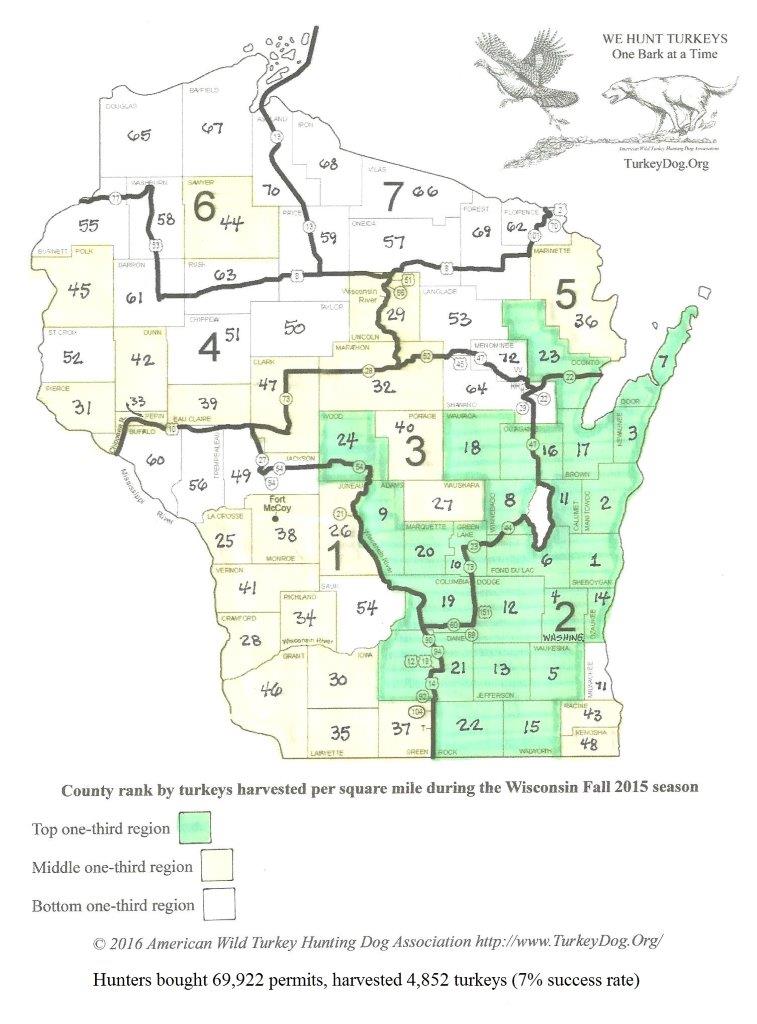 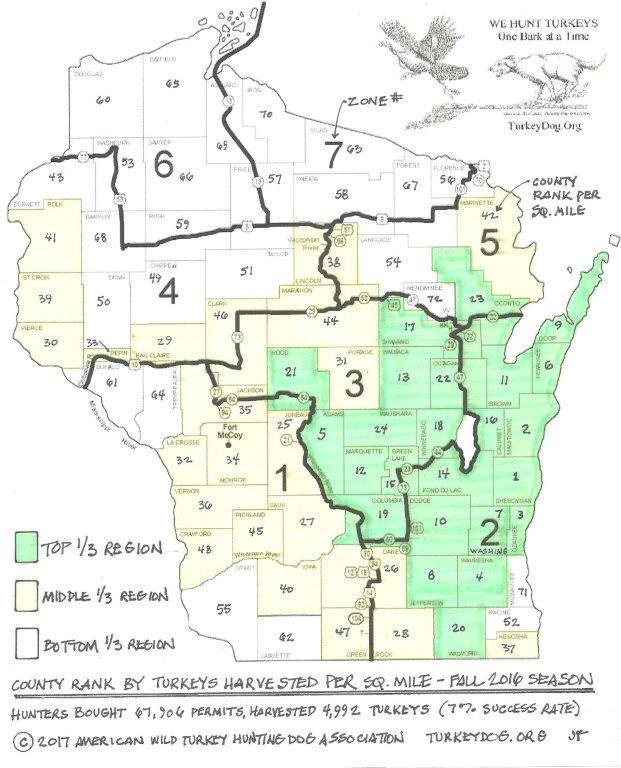 We should be spending more of our turkey stamp dollars where we harvest the most turkeys, not where the prime forest cover is, but that's another issue. With good habitat for roosting, like river bottoms with steep hills that the farmer can't farm, impenetrable swamps, or bowls in fields hidden from the road, they will do better on farm land, than prime forest cover land. ← Map on the left ranks the county kill from the Fall 2015 season in turkeys killed per square mile. Wisconsin has 72 counties, so it shows the top 24 in green, the middle 24 in yellow and the bottom 24 are not colored. Map on the right is
the 2016 Fall season turkeys per square mile. →
In 2015 the success
rate was 4,852 turkeys out of 69,922 permits or
.06939%
In 2016 the success rate was 4,992 out of 67,906 or .0735% There was 3% less hunters, but they killed 3% more turkeys. At that rate, in another 30 years or so, there won't be many fall hunters, but they'll be as good as spring hunters. Then we can close the spring gobbler season and just hunt turkeys in the fall, like it should be. Except I'll be dead by then. Jon |
| When someone says hunting fall turkeys with a dog is easy, tell them this: In Wisconsin's 3-1/2 month 2016 Fall season, hunters ranged from killing one turkey per 2.8 sq. miles in Sheboygan county (181 turkeys), to one turkey per 60 square miles in Milwaukee county (2 turkeys). Or an average of one turkey every 11.15 square miles statewide. Totals indicate calling gobblers in the Fall is about 6 times harder than in Spring. And 20 times more exercise. That's some hard hunting. |
| No
part of this webpage may be reproduced in any form by any
means,
electronic or mechanical, including photocopy, recording,
or any other
information storage or retrieval system without permission
in writing
from the AWTHDA. Write to: awthda@turkeydog.org
|
| Home | About
Us
|
Books
|
Breeds
| Classifieds
| FAQ
|
History
| Kit
Shaffer Legislation | Links | Scratchings | Spring | Stories | Tales | Shop in the Store Members are invited to send pictures of yourself and your dog, with a short story like these: Carson Quarles | Earl Sechrist | Frederick Payne 1 | Frederick Payne 2 | Gary Perlstein | Gratten Hepler | Jon Freis 1 | Jon Freis 2 | Larry Case | Marlin Watkins 1 | Marlin Watkins 2 | Mike Joyner | Mike Morrell | Parker Whedon | Randy Carter | Ron Meek 1 | Ron Meek 2 | Tom McMurray | Tommy Barham 1 | Tommy Barham 2 Members Only: Hall of Fame | Members | Museum | Studies | and the States KY | NC | NY | OH | ON | PA | TN | VA | WI | WV © 2011 - 2026 American Wild Turkey Hunting Dog Association All Rights Reserved Permission to copy without written authorization is expressly denied. |